I Don’t Know


The emperor, who was a devout Buddhist, invited a great Zen master to the Palace in order to ask him questions about Buddhism. “What is the highest truth of the holy Buddhist doctrine?” the emperor inquired.  “Vast emptiness… and not a trace of holiness,” the master replied.  “If there is no holiness,” the emperor said, “then who or what are you?”  “I do not know,” the master replied.

Here we have a devout Buddhist emperor inviting a Zen master to his palace in order quiz him about Buddhism.  It’s quite a common mistake for people to think that Zen and Buddhism are one and the same.  The truth is that they are poles apart.  Buddhism is an organised religion, although also a way of life, non-dogmatic and closer to the truth than most of the world’s major religions.  Zen, in my humble opinion, is something that happens to you; it is an awakening.  Most people experience their spiritual awakening in subtle stages that just happen without any prior warning.  There is no such thing as Zen philosophy either, so the emperor was on a hiding to nothing in asking the master, “what is the highest truth of the holy Buddhist doctrine?”

The answer came, “vast emptiness… and not a trace of holiness.”  This is very profound and clearly not understood by the emperor.  Vast emptiness refers to the inner reality; infinite consciousness, which is One.  The Indian yogi, Paramahansa Yogananda, would on occasion refer to this as , “the uncreated wilderness of bliss”, which is the same as vast emptiness.  What the master is saying is that the “highest truth” is to return to the state of “nothingness” from which we came.  This is the non-dual state, therefore “and not a trace of holiness” means that in consciousness there is only consciousness and nothing else.  In the dualistic world, if something is deemed holy, it implies that it will have a relative opposite somewhere that is deemed unholy.  This is duality and ultimately an illusion, so in the vast emptiness there will be no trace of holiness.

The emperor then came back with, “If there is no holiness then who or what are you?”

“I do not know,” the master replied.

The master answered the emperor’s question in the most perfect way possible; “I do not know.”  Enlightenment is the shedding of all knowledge.  All knowledge relates to the past and is of the mind-created world.  In “vast emptiness” there is no knowledge; only pure knowing.


Heaven And Hell


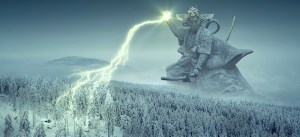
A soldier went to a Zen master and asked, “tell me, is there really a Heaven and Hell?”  The master looked at him and exclaimed, “who are you?”  “I’m a Samurai warrior”, came the reply.  “A warrior!”  Mocked the master, “what kind of king would have you for a guard?”  Look at you, you look like a beggar!”  The warrior became very angry and made to draw his sword.  “So, you have a sword do you”?  The master continued to mock.  “That sword is probably so blunt it wouldn’t even be able to sever my head. ”  The warrior flew into a rage, drew his sword and raised it above his head.  “Behold!  The gates of Hell”, said the master.  The warrior, realising what was happening returned his sword to its scabbard and bowed his head in humble apology.  “Behold!  The gates of Heaven”, said the master.

This informs us that Heaven and Hell are not places that we go to; they are states of mind that we create for ourselves.  It also illustrates how Zen is about direct experience and not the expounding of philosophy.  The soldier came to the master with a very relevant question, but rather than become the orator, the master allowed him to experience directly how he could create his own Heaven or Hell.  When the soldier understood what was going on he dropped his ego, thus closing the “gates of Hell”, which were opening up before him; in doing so he unlocked the “gates of Heaven”.

Is That So?


The Zen master, Hakuin, lived in a village next door to a family.  The young, rather attractive girl of the house became pregnant, and her furious parents demanded to know who the father was.  The girl said it was Hakuin.  Her father went next door in a rage and confronted the master, saying, “you have made my daughter pregnant and you will be held accountable for your actions”.  “Is that so?”, replied Hakuin.  The master’s reputation in the village was in tatters, and when the child was born, the girl’s parents took it to him and said, “this is your doing, therefore you will have to be responsible for the child’s upbringing”.  “Is that so?”, replied Hakuin.

Months passed and the master looked after the child with all the tender care of a loving parent.  Eventually, wracked with guilt, the girl confessed that the real father of the child was the young man who worked in the village grocery store.  The horrified and embarrassed parents went back to the master and apologised profusely for what had happened.  “Is that so?”, said Hakuin as he handed over the child.

This little story tells us two things; firstly that reputation is of the ego, it represents the views and opinions that others hold about us.  We can choose to believe those views, but if we do, we run the risk of developing a mind-set about ourselves that is not true and not representative of the light that we really are.  It also illustrates the importance of accepting “what is”.  In life we have a tendency to try to filter out anything that comes along that the mind tells us is not agreeable.  But Zen is about the acceptance of what is, in the knowledge that the world is constantly in motion, that “this too will pass” and “what we resist will persist”.  Hakuin was a Zen master; a realised soul, and he was completely unmoved by the whole sorry business.  He transcended the ego, therefore he was fully functioning in the world without being a part of the world; he remained “the eternal witness” as the drama played itself out.


The Flag


Two friends were watching on as a flag flapped around in the wind.  “It’s the flag that’s moving”, said one of them.  “No, it’s the wind that’s moving”, said the other.  They could not decide amongst themselves who was right, so they decided to consult a Zen master who lived in their region.  They went to the master and explained the story, saying, “please tell us, is it the flag or the wind that moves”?  “It is neither the wind nor the flag that moves”, said the master, “it is the mind.”

Ramana Maharshi refers to the mind (ego) as a “phantom” that rises up from the Self during waking state, and disappears back into the Self during deep, dreamless sleep.  It is also that which is found to be non-existent on realisation of the Self.  In consciousness (Self) there is no form; just pure being.  All objectification is a product of mind, and all movement takes place in mind, which is a projection of the Self.  Consciousness is constantly in motion, therefore objects rise up and fall away again.  Like the millions of waves that take form and then become immersed once again in the oceans. 

When you gaze upon the beauty of a landscape, all you are actually looking at is consciousness (energy) existing at varying degrees of vibration.  It is the mind that interprets and objectifies these vibrations, and projects the form perceived as landscape, which is seen by the eyes.


The Windy Day


Photo by Johannes Plenio from Pexels

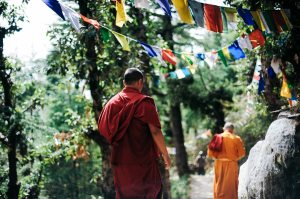
A group of monks were walking through the forest with their master on a windy, Autumn day.  Fallen leaves were strewn all over the ground, and leaves falling in the moment performed a frenzied mid-air dance as the gusting currents stamped their assertiveness. All in all, it was a real hive of activity as Mother Nature’s breath breathed life into the natural surroundings of the forest.

There came a point where one particular monk found himself to be the only one walking near to the master; one group bringing up the rear and another group walking at a brisk pace in front.  The monk was desperate to ask the master a question, and wishing to take advantage of the opportunity said, “master, I have been meaning to ask you something, have you revealed everything or are you still hiding something from us?”

The master replied, “look at my hand, it is wide open like this forest.  People who hide things are like fists,” and he reached down and picked up a handful of leaves.  Standing there with the leaves clenched in his fist he said, “see, now you can’t see the leaves, they are hidden.”  As he opened his hand, letting the leaves flutter away, he said, “I have revealed everything, if you think that something is still hidden, it is because of you, not me.”

This parable explains how we always try to project our own insecurities and issues onto other people.  It is another example of how our conditioning in early life causes us to develop traits and mindsets that become ingrained.in our psyche.  These traits are fear-based and have their roots in our inability to love ourselves.  The monk was insecure; he didn’t trust, so he tried to put the ball in the master’s court.

The truth, like the master’s open hand, is always there in nature; almost slapping us around the face; willing us to open our eyes.  But, it is like Edison and his lightbulb, it took him over a thousand attempts to eventually create his wonderful invention.  People laughed at him, but in the end he simply said that there were over a thousand steps in the process.  So it is with human beings; Mother Nature has to keep metaphorically bashing us on the head until the penny finally drops and we recognise the beauty of our own spirit, and shine our light into the world.

The Flooded Road


Photo by Wouter de Jong from Pexels

Two monks were on their way to a temple in a distant town.  They came to a road that was flooded quite badly, and as they were about to cross, one of the monks noticed a young girl who also wanted to get across.  Seeing that her clothing would have ended up saturated, he picked her up and carried her across.  The monks continued their long journey and walked for several hours in complete silence.  Eventually, the other monk could hold his silence no longer and said, “back there, that girl”  “You know that us monks are not even meant to look at females, but you carried her across the road”.  “Yes”, the other monk replied, “but I put her down hours ago.”  “You, on the other hand, appear to be still carrying her.”

This parable demonstrates the effect that old, stale mindsets and ideas can have on us.  One monk simply saw another human being that was in need of a little help and acted accordingly.  Whereas the other monk walked for hours in agitated silence, when he could have chosen instead to enjoy the journey.

This is the same as holding grudges; it does nothing but poison the spirit.  It is a human trait, to cling on grimly for dear life to old ideas that no longer serve us.  One monk is centred in the “now” and enjoys the peace and tranquillity of the journey.  The other monk has his “now” invaded by agitation, which is the result of fear.  The fear of going against something steeped in tradition.  The stupidity of it all is that it was not even his action that went against convention, but he took it upon himself to become agitated by the action of his companion.

Everything serves its purpose in its time, but the spirit is free and not meant to be tied by convention and tradition.  In observing what we believe to be old sacred traditions, we quite often only succeed in tightening the veil of ignorance that keeps us in bondage.  This also applies to views that we hold about ourselves and others, which are the result of years of conditioning.  It is the inability to let go of “that which no longer serves us” that is very often at the root of our pain and suffering.

The Mustard Seed


The disciples said to the master, “tell us what the Kingdom of Heaven is like.”  He said to them, “it is like a mustard seed; smaller than all seeds, but when it falls on the tilled earth, it produces a large tree and becomes shelter for all the birds of Heaven.

This parable demonstrates a great paradox.  The tiny mustard seed contains the mustard tree, which can grow up to about 25′ high.  The shell of the seed represents the line between the unmanifest (consciousness) and the manifest (the world or universe).  If the seed falls onto a concrete path it will simply die away, but in the correct (tilled) ground it will develop and grow into a magnificent tree.  This aptly describes the human journey.  We all start off as seeds in the womb, and as we go through all the stages of life we seek the relevant tilled earth (guru, mentor, teacher etc.) in order that we may grow.

The mother is the first nurturer of the seed; the first bigger tree in which we take shelter.  At this stage the seed disappears and dies and is reborn as a sprouting plant.  Then there are various stages, where as the plant steadily grows, teachers come and go.  These teachers can be in the form of school teachers, peers, partners, friends and even enemies.  Then in the same way that the seed must die in order to know itself as the tree, we ourselves have to die (eradicate the ego) in order to be reborn in all our glory (realise the Self)

At some stage the growing plant might decide that it wants to delve deeper and gain greater meaning to its existence, and it will seek shelter in the form of a guru; a Buddha tree, a Jesus tree, a Lao Tzu tree or a Krishna tree.  The master, in the form of whichever tree the seeker has chosen to take shelter in, will then nurture the growing plant until it becomes a magnificent tree in its own right.

At this point the newly emerged magnificent tree realises that all along it was itself the very Buddha, Jesus, Lao Tzu or Krishna tree in which it sought shelter, that all the time the tiny mustard seed and the magnificent, fully grown tree were One and the same.

This is the great paradox that is the parable of the mustard seed.

As Miserable As Ever


A master announced that one of the young monks had attained enlightenment.  This created a great buzz around the temple; and naturally aroused the curiosity of many of the young monk’s peers.  He was asked:

“We hear you have attained enlightenment?”

“Yes”

“How do you feel?”

“Still as miserable as ever.”

This beautiful tongue in cheek parable tells us that enlightenment is not something to be attained; it is our natural state and we are always that.  When we talk of “attaining”, it is simply for the sake of using vocabulary that can be understood in discussion.  From the perspective of the ego, there most certainly is something to attain.  But, this parable is telling us that when we “attain” enlightenment, it is nothing more than the realisation that we are already enlightened, always have been and always will be.  It is the dissolution of the ego, the removal of ignorance, revealing what was always there.

Here are three more examples that say exactly the same thing.  Firstly, there is this lovely ancient Chinese proverb:

Before enlightenment

Chopping wood, carrying water

After enlightenment

Chopping wood, carrying water


Secondly, one of my favourite sages, Ramana Maharshi reminds us that:

“You are already that which you seek”


And finally, this very eloquent quote from Sri Sathya Sai Baba:

“When the road ends and the Goal is gained the pilgrim finds that he has travelled only from himself to himself, that the way was long and lonesome, but, that the God whom he reached was all the while in him, around him, with him, and beside him! He himself was always Divine. His yearning to merge in God was but the sea calling out to the ocean!” 

He Who Knows


The title of my forthcoming book has changed already!  It is now called “The Road to Nowhere – embracing the totality”, and here for your pleasure (I hope) is another extract to be…

A group of disciples were in the temple one morning awaiting the arrival of their master, Lao Tzu.  As they waited, they pondered the meaning of one of the great master’s teachings:

He who knows

Does not speak

He who speaks

Does not know


When their master appeared, they asked him to elaborate on the meaning. Lao Tzu responded by asking them if they had ever experienced the fragrance of a rose.  Every single hand went up.  He then asked the question, “who among you is able to explain it to us?”  No hands went up.

And this lovely little parable aptly demonstrates, that for some things, there is simply no explanation.  Just how would anybody describe the fragrance of a rose to any degree of accuracy?  There are simply no words in the dictionary to describe such beauty.  The same can be said of enlightenment, which for me is the meaning contained within this teaching.  I do not for one minute claim to be a fully realised soul.  However, I am going through a tangible awakening process that has been happening to me in stages for some years now.  There are many words that I could use to describe my experience; emergence, awakening, eureka moments to name but a few, but none of them would come anywhere near an apt description.

I have heard people use the expression, “I am awake”.  But ultimately, this is only the ego speaking.  To make the statement “I am awake”, or “I am enlightened”, implies the existence of opposite states of being asleep or unenlightened.  This is duality.  In consciousness there is no duality; there is only One, therefore, a truly awakened individual would not offer any explanation of being awake or otherwise.  They would simply abide in the true nature of their Being; infinite consciousness.

Ramana Maharshi also has a take on this, which I find quite beautiful.  He said that “truth has no words” and that “silence is the eternal flow of language, obstructed by words”.

This Too Will Pass


I’m off on my travels again in a few days.  As I’ve got a bit of time on my hands before I go, I thought I would try to rattle off a couple more blog posts keeping with the Zen parable trend of late.  This is another one destined to grace my up coming book…

There was once a king who lacked confidence and was constantly worried that an army would one day come and take his kingdom.  He heard that there was a great Zen master in the region and he sent one of his servants to go and bring him to the palace. Sure enough, the master did as the king requested and he accompanied the servant to the palace.  The king said, “I have heard that you are a great Zen master and I want you to make me as wise as you”.  The master said, “that is impossible your majesty, I can’t do that.  However, I would like to help you but it means that I have to return tomorrow”.

The master was true to his word and he duly returned the next day.  He produced a small wooden box from his robe and on giving it to the king said, “what is contained in this box is so important that you must never open it unless you find yourself in dire circumstances with all hope lost”.  The king thought it rather strange, but nonetheless he thanked the master, who went on his way.

Time passed and the king’s greatest fears were realised.  A rival army did indeed attack and take his kingdom, and the king had to flee for his life.  He took to the forest and ran for all he was worth.  As he ran he could hear the sound of the chasing soldiers on their horses.  As the horses gained ground on him he could hear the sound getting steadily louder.  He kept on running, but suddenly; to the king’s horror, he was faced with a ravine, which was as deep as it was wide.  He had nowhere to run, and as he contemplated his fate, he suddenly remembered the small wooden box that the master had given him.  He took it out of his pocket and opened it.  Inside, underneath the lid, was an inscription of four words, which the king read to himself, “this too will pass”.  He stared at the inscription, and trying to understand what it meant, repeated the words in his mind, “this too will pass, this too will pass”.

The king suddenly realised that he had been so engrossed in contemplating the inscription, he hadn’t noticed that the sound of the galloping horses was fading into the distance.  He couldn’t believe it; the chasing soldiers must have taken a wrong fork in the road and were now long gone.  The king lay low for a few days and then traced his tracks back and found an alternative route.  He travelled for many weeks, foraging for food on the way, until he came to a village.  Nobody knew him as a king and the villagers were friendly, inviting him to stay.  He settled down, and as time went by he eventually married and had a couple of children.  He was extremely happy and contented.

One day, after some years had passed, the former king was sorting through some of his belongings.  He came across a small wooden box that looked vaguely familiar.  Out of curiosity he opened it, and underneath the lid he saw the inscription, “this too will pass”.

This parable is a reminder of the impermanent nature of the world.  The only thing that is guaranteed, apart from our eventual exit from this life, is change.  We live in a world that is in a constant state of flux; that is forever moving in cycles.  It is a reminder that we ourselves are not these forms that we call bodies, but rather the substratum on which “the dance of life” is played out.  The parable is not telling us that we should not enjoy the dance and embrace all the beauty it has to offer, but it reminds us that we shouldn’t get too attached to the niceties of life because they will not last. Enjoy the adventure, whilst at the same time understanding that life is like a river constantly flowing towards the ocean into which it will merge and that, “this too will pass”.