Contextual Penance


I saw on social media recently that someone posted the following passage from the Bhagavad Gita. I wanted to share it before continuing because it kind of ties in with what I wanted to write about.

The soul is neither born nor does it ever die. Having never existed will it ever cease to be? The soul is birthless, eternal, changeless, immortal.

Bhagavad Gita 2:20

I’ve come to realise even more recently just how difficult the spiritual pathway really is. Before I continue, did you notice what happened there? I made a very contradictory statement; “the spiritual pathway.” There is no pathway or journey because ultimately, the only reality is Consciousness, which exists exactly as it is, as seamless eternal bliss, love, infinite awareness; the list of names we could call it is endless. I’ve written about this before, and you can see that we haven’t even gotten into the post properly yet, but things have become complicated. This is just one reason why the “spiritual pathway” can be such an arduous “journey.” As if life wasn’t challenging enough, we are hampered on our way by language; or to be more precise, the limitations of language. The main crux of this post cannot be aptly explained with any words from any dictionary in any language. What we have to do in these situations is use the words that fit best with what we want to say, even if it isn’t going to be 100% accurate.

I have come to the conclusion that pretty much all forms of spiritual practice are a bit of a red herring and ultimately can never be anything more than stepping stones as we blunder and stumble our way through life. I’ve realised lately that no matter how spiritually evolved we believe ourselves to have become, life doesn’t get any easier, in fact, there’s a good argument to suggest that it just gets harder. Now, I am about to get to the point; honest, but just one more thing before I do.

In order to negotiate life’s hurdles, I have found that it really does help to understand that everything along the spiritual pathway (there I go again, making contradictory statements) has context, and my truth may not be your truth and vice versa.

There are many examples of spiritual practice, but the one I want to focus on for the purpose of this article is the practice of “Surrender.” The reason being, that it’s a great example of what I’m trying to put over. For the uninitiated, I shall try to explain using my very limited understanding of the Hindu religion. In Hinduism, there are three recognised pathways to enlightenment; Bhakti (devotion), Karma Yoga (selfless service to humanity) and Surrender (complete surrender to God). I’m happy to stand corrected on this and I’m sure that in India these three pathways are not restricted to Hindus.

I’ve been struggling quite a lot recently with my mind causing absolute havoc, and it was during one such struggle that I came to the conclusion that no matter what we think we are doing with regard to spiritual practice, there is something underlying in the driving seat, going largely unnoticed and quietly going about its business, and that something is Consciousness simply being itself. It was during this moment of struggle that I had the epiphany regarding spiritual practice, and Surrender specifically came to mind. It seemed to me that to practice Surrender, the aspirant must delve into the world of illusion in order to ultimately gain something that he/she already has.

To clarify, we must first objectify a deity that exists as a separate entity from ourselves, in order to then surrender to it. The outcome of which, we hope, would be that we become enlightened. Considering that our true nature is that of the aforementioned Consciousness, which exists simply as itself, we would have to give credence to the illusion of subject/object (seer and that which is seen); also known as duality, we would also be affirming this illusion with our “spiritual” practice, and for what? To gain something we already have. This is where context comes in.

I’m currently experiencing a turbulent time with regard to my mind and the thoughts it’s throwing up. However, I am big enough and ugly enough to know that this turbulence is of my own making, and this gives me the power to be the captain of my own skateboard (I just made that saying up). When I cast my mind back 20 odd years, I was in an awful psychological state, and the “Me” that existed then would not have had a clue what all this Surrender malarky is about. Instead, I eventually started a journey of spiritual practice that got me out of that predicament and set me on the road to becoming who I am today. The practices I undertook back then would be considered very inferior to the practice of Surrender, but in the context of where I was and what was going on with me, those practices were valid and exactly what I needed.

To conclude, within the context of the illusion of duality, which we are all experiencing at this moment, all spiritual practices have some form of relevance in relation to where we are as individuals. I see them as a kind of penance, but not in the harsh, religious sense. They are simply a way to go about opening the doors of evolution for the soul who is floundering and lost. This now brings me back to the beginning and that quote from the Bhagavad Gita. Ultimately, there is no individual soul, there is only Consciousness having the adventure of experience, driven by itself, within itself and of itself.

Consciousness is unable to have this experience without veiling itself in ignorance. Paradoxically, the “gift” of duality is the way back from this ignorance to enlightenment. Enlightenment being the realisation that we are already enlightened, and ultimately, that there is no such thing as enlightenment.


I’m Back


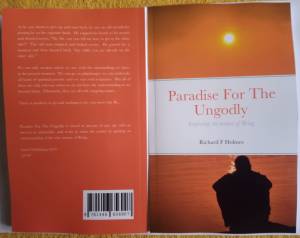
Well, I don’t think I’ve ever had such a long gap in between blog posts before. It’s been over four months since I last posted back in August. I wouldn’t say that my barren spell has been down to writer’s block. Far from it, I just seem to be going through a strange transition period; there have been changes in my life and blog posts have never been further from my mind. However…I haven’t been completely idle. After many months of procrastination, I have republished my last two books as second editions. A few years back, I removed all of my books from sale because I didn’t feel that they represented who I am anymore, not fully anyway. But, Paradise For The Ungodly is now published again, and available only directly from me, and I am waiting for the proof copy of Eyesight To The Blind to arrive. Once I’m satisfied that all is in order, I shall click on the button and it will be available to purchase on most major book sales platforms, including internationally.

I have tinkered with both books, removing bits here, adding bits there and also rewriting passages that don’t seem quite right five years down the road. To tease your taste buds, I have posted the covers below. They are only in the form of photographs, taken online, at the moment. But, I will be updating with better quality pics in due course. See you soon.

Do Not Chase The Tail


I saw what I thought was an incredibly funny cartoon on social media recently, although I believe they are called memes these days. It was a take on the classic old spiritual thing of a seeker going up a mountain looking for a guru and/or enlightenment. The only thing was that this cartoon features dogs and not humans. I wish that I’d kept a copy because I cannot remember the caption word for word, but I think you will still get the gist of what I’m trying to say. Our intrepid canine friend reaches the mountain peak and there finds the wise guru dog sitting on a throne. The caption went something like this:

“Chase not the tail, for the tail is already yours”

Apart from finding it rather amusing I also found it very profound and it reminded me of something I’ve written about several times in the past. However, I’m not going to repeat myself here, I’m going to leave that to the masters:

“You are already that which you seek” – Ramana Maharsh

“Before enlightenment chopping wood, carrying water

After enlightenment chopping wood, carrying water” – Old Chinese proverb

“When the road ends and the Goal is gained the pilgrim finds that he has travelled only from himself to himself, that the way was long and lonesome, but, that the God whom he reached was all the while in him, around him, with him, and beside him! He himself was always Divine. His yearning to merge in God was but the sea calling out to the ocean.” – Sri Sathya Sai Baba


Differences


I remember many years ago when I was in the infants school, there was a Jewish girl in my class called Isobel Jo Rosenstein. When we had religious education (RE) classes, she would have to go and sit in a classroom all by herself because the RE classes were Christian based. Things might be different in schools these days; I’ve heard of some schools actually teaching all the major religions. But, recently, I’ve been thinking about Isobel even though I haven’t seen her for over 60 years. It occurred to me that at a very young age (we would have been around 5 or 6 years old) we were already being taught about division and difference. Now, I’m sure that Isobel’s parents were more than happy for her to be segregated instead of risking her being indoctrinated through the dogma of another religion. But It occurs to me that us kids were being taught that if someone was a bit different to us, then they should be segregated; almost “quarantined.” I like to think that today, Isobel would be welcomed into an RE class and invited to give her classmates a bit of an insight into her religion.

Now fast-forward from those days of ostracization to the recent news that the Church of England has appointed its first transgender archdeacon. This of course, is a huge step forward for the church, although inevitably it has caused division. To say that some “feather ruffling” has taken place would be an understatement. Within a certain context, I feel that this is a huge event for the LGBTQ+ community, who have had to battle in the face of adversity for so long, just to be regarded on an equal footing with so-called “normal” people. It’s great that diversity can be celebrated instead of being feared and discriminated against. Having said this, for me there is the bigger spiritual picture.

It most certainly is wonderful the way many of us celebrate diversity these days, how we see our differences as something that can bring us together. In the UK, for example, we have come a long way since the days when there were signs displayed in the windows of guest houses that said, “No dogs, No Irish, No coloured.” But, in ultimate reality we are all One consciousness; in truth, there are no differences. Until our species learns to look beyond differences and simply celebrates the beauty of who we are, there are going to be problems. There will always be bigots and there will always be sections of the community that will be the subject of bigotry.

“we are all One” is not a throwaway comment born out of new age ideology, it is an actual “thing.” There is only One soul, which is you…and me…and everyone else on the planet and beyond. We all shine with the same light because we are the same light, we all exist within the same field of infinite consciousness because we are that field of infinite consciousness. I think it’s too much to ask or expect, that all people everywhere suddenly see beyond the surface and gaze upon the beauty of the soul, but we are getting there, albeit slowly, and that is surely something to be celebrated.

Status: Is There Any Point?


There is an old Italian proverb that goes:

At the end of the game both the king and the pawn go back in the same box.

I love that proverb. If you take it at face value, it is surely telling us that in life, it doesn’t matter who we are, we all end up leaving in a box. (Yes, I can hear you nit-pickers out there, saying not everyone goes in a box), but metaphorically, it is true. I, however, like to look at this proverb from a deeper level because this is where I think the beauty lies. For me, what this proverb is telling us is that status in life must be one of the most pointless things ever. Our true nature is that of consciousness, therefore we own nothing because we need nothing, and in ultimate reality, there is nothing to own. The same can be said of “owning” some sort of status, whether that be monarch, politician, mayor or company chairman. All such titles are superficial and any feelings of superiority are mind (ego) constructed. Life is very non-discriminative, when it comes calling it pays no mind to how much money you have in the bank or your job title.

Of course, let us also remember that as a species, we have the habit of imposing status onto others too. We describe other people in various ways, not all of them complimentary. in fact, we can be very creative and colourful in our descriptions of others. I think that this proverb is a very gentle reminder for all of us to stay grounded and to be aware that regardless of what is going on, on the surface, we are internally all one consciousness. Whether king or beggar, life can bite you on the ankles when you least expect it, so be kind, try not to judge and be grateful for everything that life offers.


If You See The Buddha Kill Him – Part Two


Following on from my post from May 22nd, here are a couple of very apt quotes I came across in the book The Zen Teachings of Bodidharma authored by Red Pine and published by North Point Press ISBN 978-0-86547-399-7. They really resonated with me so I thought I would share them.

At the appearance of spirits, demons or divine beings, conceive neither respect nor fear. Your mind is basically empty. All appearances are illusions.

Eyes that aren’t attached to form are the gates of Zen.


If You See The Buddha Kill Him


If You See The Buddha Kill Him is probably the most famous quote from the great Zen master and man of myth and legend, Bodhidharma. Taken literally, one would expect that it would be a very tongue-in-cheek thing to say. especially as the great Siddhartha Gautama (better known as The Buddha) had already long since left this life by the time these words were said to have been uttered. However, when we look deeper into this statement from the perspective of what Bodhidharma actually meant, we find something very profound indeed. For me, in my very  humble opinion, the meaning is twofold, and I shall share both views in this post.

Firstly, if you see someone coming towards you and he/she looks and acts like a Buddha (an enlightened one), then you can bet your life that it is not a Buddha. Buddhas walk among us unnoticed because awakened souls tend to be very unassuming and do not stand out from the crowd, not in the sense that the phrase “standing out from the crowd” is usually meant. Buddhas don’t need to stand out from the crowd from a “display” point of view because they reflect the light of consciousness wherever they go and mostly, only those who are spiritual seekers would recognise a Buddha-like act or gesture. A good example of this is the sage Ramana Maharshi. When the Maharshi first awakened, after a short space of time he made his way to the village of Tiruvannamalai, which sits at the foot of the holy mountain of Arunachala. He never left the area again until he gave up his body on the 14th of April 1950. He pretty much owned only the loin cloth on his back, nothing else, yet people from all over the world were attracted to his ashram, including the likes of Carl Jung and Somerset Maughan, simply because he reflected the light of consciousness.

So, the meaning of “If You See The Buddha Kill Him” from the above perspective, is don’t follow people who claim to be spiritual teachers, gurus and sages because if they were teachers, gurus and sages they wouldn’t have to make the claim.

Secondly, the meaning has to do with how people who are spiritual seekers quite often get attached to seeing clairvoyant visions, not realising that developing these types of attachments to psychic powers etc. will only hinder the quest for enlightenment. Clairvoyant visions (such as a vision of The Buddha during meditation) are not unlike our view of the world in day-to-day life. They are temporal forms that appear and disappear. That which appears and disappears is an illusion. The forms themselves are only real in that they are made, or comprised if you like, of consciousness. Consciousness is the eternally flowing river that never stays the same, hence form appears and disappears There is also the subject/object thing (the seer and that which is seen) going on here, which is duality and therefore also an illusion.

So, this is the meaning of “If You See The Buddha Kill Him”  from the above perspective. Do not get attached to or desire to develop psychic powers because this practice will only hinder your spiritual journey. Those who attain Buddhahood automatically develop such powers, but they see them for what they are and don’t worry about them. The attainment of Buddhahood or enlightenment is simply the realisation that you always were, are now, and always will be A Buddha, that once you attain Buddhahood the Buddha disappears.

Arrogance Or Ignorance?


I recently attended a death café in my local area. If you are not familiar with the concept of “Death Café” it is well worth looking up on Google. I attended my first one a year ago this month; they are extremely inspirational events. Very briefly, it works on the principle that death is a very taboo subject for the vast amount of people, rather like the elephant in the room; if you ignore it long enough it will go away. So, death café, is a safe and comfortable space where people can come together, usually with refreshments, and discuss their thoughts and feelings around death and dying. What I personally like about these events is that there is no agenda; all views are valid and they are not religious or bereavement support groups. Depending on the number of attendees, people split into groups and the discussions tend to be very interesting, usually lasting for about an hour.

One lady who was in my group raised something that really got me thinking. She was talking about the cycles of nature and saying that every time she saw the Spring blossom growing on the trees, she always wondered if it would be the last Spring blossom she ever saw, as we never know when our time is going to come.  

That got me thinking about our species in general. Us humans are made of the same stuff as the rest of nature, the universe and beyond. So, if nature moves in cycles before our very eyes, constantly replenishing itself, does it not stand to reason that it is the same for the human race. After all, it has been scientifically proven that you can neither create nor destroy energy, and all of life, all of creation is energy. Why on earth would people think that, “when you are dead you are dead” or that a demonic god is going to cast some of us into eternal paradise and some of us into the eternal fire. Is it arrogance, that we think we are so superior that we have our own laws of physics separate from the rest of creation. Somehow, the universe has given the human race its own set of natural laws in recognition of our “loveliness.” I don’t think so, I think that it is ignorance, the ignorance of who we really are. I think that we succumb to our conditioning from a very early age during each lifetime and that this contributes greatly to our forgetting who we really are. 

It’s all part of the fun I suppose; the fun of remembering. And… for the life of me, I cannot understand why this business of energy (in relation to humans) replenishing itself has never occurred to me before.

The Road To Nowhere


Ikkyu 1394 – 1481

I believe that I’ve covered this concept before. However, I don’t think that I’ve ever had a truer understanding of what it actually means until now. Stuff that I’ve been reading lately coupled with my own experiences have really brought home to me that there is no destination apart from the actual journey. Wherever we find ourselves in any particular moment is our destination; it is Divinely and perfectly exactly where we need to be in accordance with the soul’s agenda (desire), and the soul’s desire is the only thing that matters. It is also a reminder that we do not have to search for anything in this life; we are already that which we seek.

Life is an eternal series of cycles that gives consciousness the opportunity to express and know itself through the physical form. It is also the process via which the individual soul evolves into the remembrance of its true nature (consciousness).

I’m reminded also of the quote from ancient Japanese Zen master, Ikkyu:-

“Having no destination I am never lost.”