Sometimes We Have To Be Careful How & When We Help Those In Need #2


During my first visit to Puttaparthi I had enlisted the “help” of a taxi driver called Mohan, who had been recommended to me by my good friend Satyan, from Bath here in the UK.  But as things turned out it became apparent that Mohan was probably not as honest as the day is long and I suspected that he’d ripped me off on a number of occasions.  However, because I wanted our journey to be as smooth as possible, and I especially wanted Ciara and I to avoid the hassle I’d had on my previous visit, I decided that it was best to go along with the devil I knew.  So I contacted Mohan via email and we arranged that he would meet us at Bangalore Airport.  Many years ago the journey from the airport to Puttaparthi had been long and arduous.  But these days with the more modern road system it’s now only about a two and a half hour drive.

We’d decided that we were going to do something for those less fortunate than ourselves and it appeared to be a toss up between orphans and the hungry.   As we entered the outskirts of the village Mohan pointed to a building on our left and informed us that it was an orphanage.  Ciara and I looked at each other and knew straight away that we wanted to do something for the kids.  But I was a bit suspicious that we had not even reached our destination,  yet Mohan appeared to be bringing up the subject of money already.  Anyway to cut a long story short, we decided that we were going to buy rice for a village near Puttaparthi where, according to Mohan, there was a need, and we were also going to take some things to an orphanage.  The plan was that Mohan would organise the food with a local restaurateur he knew.  On the day he would pick up the food, then us; then we would drive to the village.  From there he would take us to the orphanage.  Ciara and I would pay for the food and all the stuff for the kids and Mohan, as his seva (service) would provide the transport.  Sorted.

I had brought with me some cheap supermarket biros from the UK to give out to the kids because they go mad for them in India; the humble biro that we all take for granted.  Ciara went into a shop in Puttaparthi and bought a load of books, pens and sweets; and try as she might, with all her Irish charm, wit and tenacity to haggle a discount from the shopkeeper, he would not budge.

The day arrived and Mohan picked us up with the food already loaded in the car.  He then asked for 200 rupees so that he could go and buy paper plates and cups.  I knew that the plates and cups cost nowhere near 200 rupees, but he did not offer me any change.  I was starting to get a bit frustrated with him, because even though 200 rupees was less than £3.00, in India paper plates and cups cost literally pennies and he was blatantly taking liberties.  He then said that we would go and buy a large container of drinking water.  So, he pulled up at a kiosk in a side street where he obviously knew the vendor.  There was a discrepancy here as well as he took twice as much from us as what the vendor appeared to say the actual cost was.  Again, it was a small amount of money, but the fact that he was seemingly blatantly ripping us off was becoming a source of increasing frustration for both of us.

There was more to come though.  We arrived at the village just a few killometres outside Puttaparthi and we were obviously expected.  But what greeted us was not a mass of starving people.  Indeed they all seemed rather healthy and not the least bit malnourished.  But first things first.  Before eating, the food had to be blessed and there was a priest on hand at the very tiny temple to do just that.  Mohan said we had to make a donation too “only notes” he said “no coins, 100 rupees”.  This again was ridiculous, even though 100 rupees was only about £1.15, nobody is expected to give that amount in these situations; I ended up putting 50 or 70 rupees in the temple.  Once the ritual blessing was over we dished out the food which seemed to go down well and all concerned seemed happy.  We did however have our concerns about the food and what Mohan had charged us for providing it.  It was only rice with a bit of sauce after all, and even with the cost of the container hire taken into consideration, it would not have come to any where near the 1000 rupees he took from us.

When the food was done and dusted there was another unexpected turn of events.  Ciara and I thought we were jumping in the car and heading back through Puttaparthi to the orphange we’d passed on the day of arrival.  Wrong!  Mohan informed us we were going to the village school.  We were not happy about this but he told us that some of the kids were orphans, so we went along for the ride to see what the situation was.  What followed next somehow made everything all right, but not before we had another disappointment.  It was only a very short drive from the temple to the village school, probably less than a quarter of a mile along what was more like a dusty track than a road.  We were very disappointed to see that along the way there were people who had not taken part in the feast, probably because they had been excluded.  We also saw a fairly elderly woman laying down outside one of the ramshackle houses who was obviously lame; these were the very people that we wanted to help but it was apparent that they had not been invited to eat.  Our opinion of Mohan dropped even further when just before returning to Puttaparthi, we were invited to take tea with him in one of the houses.  It turned out that the man of the house was one of Mohan’s relatives; giving clarity to the fact that he had simply used us to feed people who were not really in that great a need, in a village where he had connections, in order that his own standing in the community would be raised.

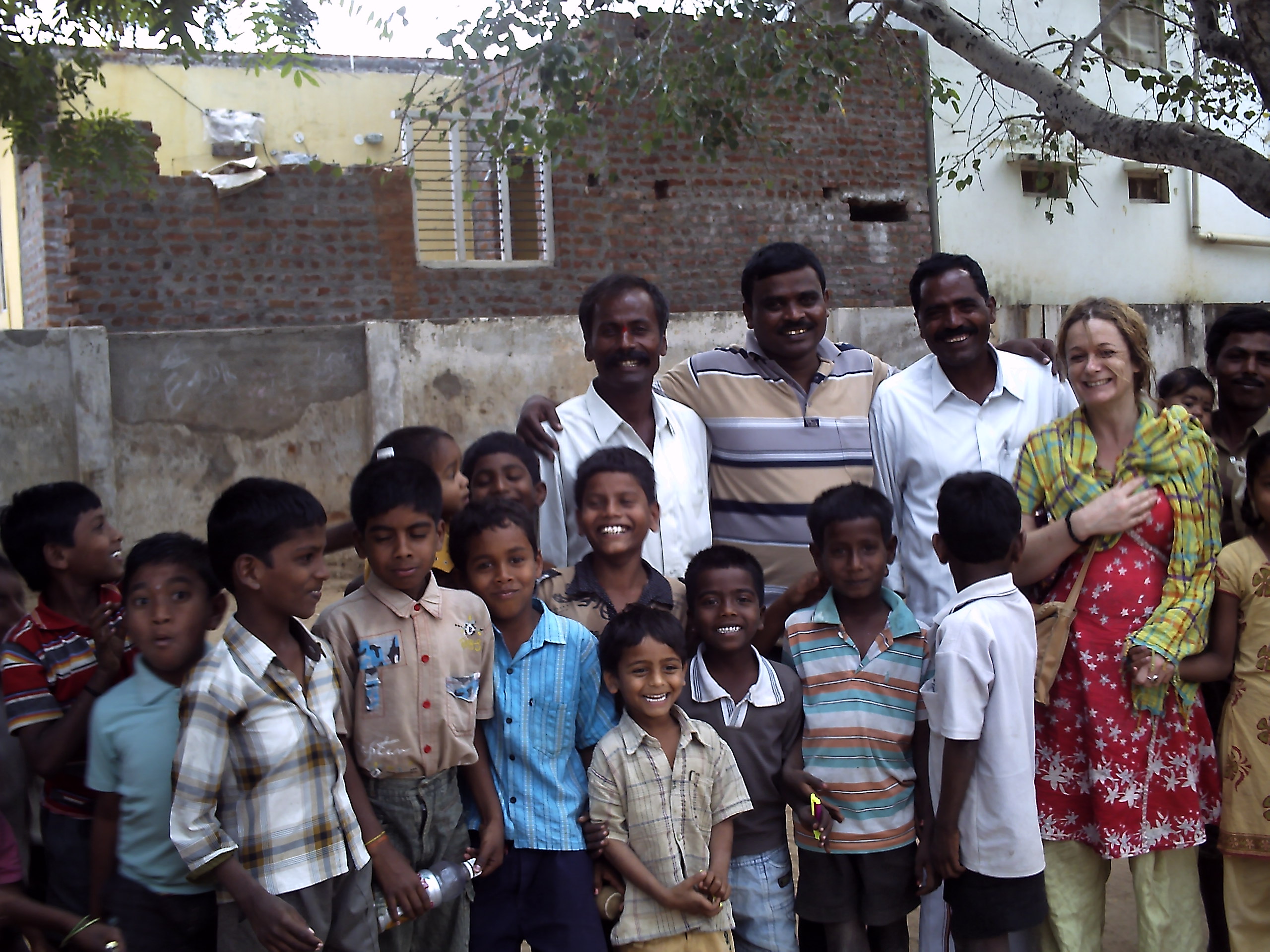
Thankfully our experience with the kids made everything seem worthwhile.  It was a very small school, just two classrooms that were very basic with plain stone floors, and none of the kids wore shoes.  They were just adorable and so excited to see us.  Seeing their huge beaming smiles and the looks in their eyes was absolutely priceless.  We were greeted with equal excitement in both classrooms, and as we gave out the books, pens and sweets it served to remind me of how different the cultures are.  The kids were absolutely over the moon in receiving these very, very basic books and pens and it emphasised to me how lucky we are in the West and how much we take the basics in life for granted. The excitement in their faces was quite something to behold.  Below are a few photos of the temple, the villagers and one of Ciara with some of the kids (if you click on them they should enlarge).  The conclusion to this story will follow shortly, in the meantime thanks for reading.

Fly


It’s only a problem having doubts when we don’t face and overcome them.  Your seeming lack of self-assuredness simply highlights the fact that you have gone into the matter free of ego.  Fly dear friend, fly…. and when you reach your destination create another one to aim for.

With Love

On Your Own Side


It’s impossible to make much progress if you’re busy clinging to the very things that hold you back. At some point you must decide whether you want to truly move forward or not.

When you constantly have to work against your own negative habits and thought patterns, success will continue to elude you. Real achievement begins the moment you make the firm commitment to put yourself on your own side.

You think thousands of thoughts and take hundreds of actions on a daily basis. Within those thoughts and actions there is enormous opportunity to make real, substantial progress.

How much of that abundance of opportunity are you utilizing to move your life forward? And how much is being wasted, or even worse, pushing you backwards?

When you replace a negative, destructive habit with a creative, productive one, you get a double gain. You are suddenly free from something that was holding you back, and on top of that there is a new force working to move you forward.

Use your thoughts, use your words, and use the actions you take each day to put yourself squarely on your own side. And you’ll be well on the way toward whatever you choose to achieve.

Ralph Marston

Healing Is


Healing is…

….releasing from the past. It is retraining my mind so as not to see the shadow of the past on anyone. It is learning not to make interpretations of people’s behaviour or motives. It is letting go the desire to want to change another person. It is letting go of expectations, assumptions, and the desire to control or manipulate another person…

Healing knows that forgiveness is the key to happiness and offers me everything that I want. Healing knows that the only reality in the universe is love, and that love is the most important healer known to the world.

To heal is to trust in a creative force that is loving and forgiving, and to know in our hearts that there is no separation and we are all joined in love with God and each other. It means that all hearts and minds are joined as one…

Healing is letting go of the fearful child so many of us carry inside, and awakening to the innocent child who has always been within us.

Healing is…

….peeling away the barriers of fear that keep us unaware of our true nature of love, peace, and rich interconnection with the web of life.  Healing is the rediscovery of who we have always been.

Gerald Jampolsky.

Sometimes We Have To Be Careful How And When We Help Those In Need


This article relates to the second time I visited the ashram of my beloved Swami, Sri Sathya Sai Baba in Puttarparthi, Southern India during February 2010.  On this occasion I went with a companion; my girlfriend Ciara, who is now my ex-girlfriend.  Those of you who have read my book Astral Travelling, The Avatar and Me will know that Baba’s ashram, Prashanthi Nilayam  (abode of the highest peace) was extremely busy during my first visit.  Literally millions and millions of people pass through the ashram each year, and especially during festival times it is just manic.  I had not planned my visits to specifically coincide with any of the festivals, it just happened to turn out that way.  During my first visit of two weeks duration there were two celebrations, and my second visit coincided with Maha Shivaratri (Great Night of Shiva) which is one of the main festivals of the year and an extremely busy time.

Ciara had an on- going medical condition and was in a lot of pain for much of our ten day visit.  Our plan was to stay in a hotel for the first night and then find accommodation on the ashram for the remainder of our stay.  However, we didn’t realise that we were visiting Prashanthi at one of the busiest times of the year.  So, taking into account Ciara’s painful condition, we ended up finding a room in the village and just stayed there for the duration.  The village was absolutely heaving; I had never known crowds like it; it made my first visit seem like solitary confinement!

Puttaparthi is not unlike any other Indian city, town or village in that there are many beggars and others who are unbelievably poor; some of these people are also hideously deformed.  Ciara and I had decided that we wanted to give something and we kind of planned it before setting off.  We had a particular “feeding project” which I will speak about in part two of this post.  But, we also wanted to do stuff spontaneously.

Swami did not encourage giving money as it does not cure the problem.  He always used to say “if you want to give something, give food”.  So we decided that as well as our main project we would try to alleviate the hunger of these souls on a random basis as well.  Rightly or wrongly I got into the habit of buying packets of biscuits (“cookies” for those in the US) and bottled water or soft drinks.  If we saw someone who looked in need of sustenance we would hand these out randomly.  Sometimes we would buy samosas and on one occasion I remember buying some takeaway rice dishes.  We would also take any food with us that we were unable to eat after dining out, and just give it to the beggars.  So now I’ve painted a picture for you I’ll get to the point of this article.

At the best of times Westerners, and even rich looking Indians, cannot walk around in places like Puttaparthi without being harassed for money by beggars and other chancers, but once it was noted that we were giving out goodies we were surrounded literally in seconds by street kids jostling to take anything from us that we were willing to give.  These experiences were great eye openers for Ciara and I, and I found it quite disturbing how these children, so young, were so cut-throat and ruthless, and so “professional” in the way they went about their business.  It’s well publicised that in India kids like these are put out onto the streets by unscrupulous adults, who are often relatives, in order to “earn” money.  In many cases the money goes to feed the alcohol addictions of the adults.  But it was apparent that amongst the kids there was most definitely a pecking order.  There was one little girl who stood out head and shoulders above the rest.

I am not very good at guessing ages, but I would put her at about ten years old.  On one occasion we had witnessed her taking a vicious swipe at a young lad; it seemed as though he had strayed onto the wrong patch, as though it was a turf war.  But he was alone, he was hurt, and it appeared that there was at least one adult giving him grief as well.  We managed to get him out of the scrape and he didn’t forget.  Whenever he saw us after that he gave us a wave and flashed a wonderful smile.  But I digress….

On this particular day we’d bought some packets of biscuits and some soft drinks, and as usual we were looking for the right people to help.  We walked down from the ashram into the village and we saw an elderly lady begging.  We stopped and when I gave her a packet of biscuits and a drink her eyes lit up. Within seconds we were surrounded by kids from all sides.  The little girl in question was at the fore hassling and jostling, and I am not exaggerating when I say that I have  to cast my mind back a long, long way to remember the last time that someone was so full-on in my face.  Now I am not someone who only has a modicum of life experience.  I have served in the military and I have lived in a foreign country, but I can honestly say that I felt intimidated by this little girl.  Ciara and I had a genuine fear that the kids would beat up on the elderly lady and take her biscuits and drink, so we had to stand there with her to make sure she was OK.  I actually felt quite bad about this because we wanted her to be able to enjoy her surprise snack in peace, but she had to stand and rush her drink
because of the kids jostling.

In amongst this there was one very amusing moment.  At some point of calm I dropped something.  What I dropped I can’t remember, but the elderly lady and I both bent down at the same time to pick it up, and there was a “CRACK” as our heads clashed.  Because she was so frail I was panic stricken that I had hurt her, and she was equally horrified because she thought the same about me.  We ended up just laughing.

So the whole point of this is to remind us that in this kind of community in places like India, there is most certainly a law of the jungle that Westerners don’t readily notice; and if we are not careful we can end up causing big problems for the very people we are trying to help.  It’s very easy to become attached to the emotion of it all, seeing those poor street kids in their rags begging for food, seeing the elderly beggars, the beggars who are obviously also mentally ill, and there are those who are inflicted with deformity as well; we really do witness heart wrenching sights in these places.  The reason we have to be careful is that we are only there for a few weeks at a time and if we single out individuals for preferential treatment during our stay it can create repercussions when we have gone.  We don’t realise that there is a lot of jealousy in these communities and that the people whom we help during our short stays may then be ostracized or even face beatings once we have gone.

Yes it is a very difficult one but nonetheless it reminds us that when we are in someone else’s back yard we need to be aware of the rules.  Watch out for part two.

Our Deepest Fear


Our deepest fear is not that we are inadequate.  Our deepest fear is that we are powerful beyond measure.  It is our light, not our darkness, that most frightens us.  Who am I to be brilliant, gorgeous, talented, and fabulous?  Actually, who are you not to be?

You are a child of God. Your playing small does not serve the world.

There is nothing enlightening about shrinking so that other people will not feel insecure around you.  We are all meant to shine, as children do.

We were born to make manifest the glory of God that is within us.  It is not in some of us, it is in everyone; and as we let our own light shine, we unconsciously give others permission to do the same.

As we are liberated from our fear, our presence automatically liberates others.

Nelson Mandela

Walk Away From Worry


Most of the things you worry about are not worth the time and trouble you take to worry. And all that needless worry distracts you from other, more productive, creative and joyful things you could be doing.

With every worry also comes the option to let it go. You can feel the worry, see it for what it is, and then choose to immediately walk away from it.

As soon as you do, your mind becomes vastly more clear and more focused. Your spirit experiences a glorious refreshment.

When your mind is filled with worry, just imagine how wonderful it would be to have that heavy burden lifted clean away. Imagine it, and then choose the simple act of doing it.

Choose to walk away from worry, and lift that burden from yourself. In a moment, your worry can be gone.

Breathe in the sweet, refreshing air of freedom, clarity and effectiveness. Walk away from worry, and walk forward with positive purpose.

Ralph Marston

Pure Beauty


There is only one reliable mode of transport in life…. the crest of the wave on which love rides as it is transmitted from one heart to another.

Courage Is…..


Courage is what happens when your desire to make positive progress is greater than your fear of a negative setback.

Courage is what happens when you look at those fears, listen to them, learn from them, use them to prepare, and then move boldly forward.

Courage is how problems are turned into opportunities. Courage is why some people are able to move the situation forward though there seems to be no hope.

Courage is when you do what you know is right, even if it is the more difficult and unpopular choice. Courage is something that builds new strength each time it is exercised.

Courage is not something that you must obtain or struggle to develop. Courage is a choice that can be yours the moment you decide to use it.

When the goal is worthy and filled with meaning, the courage to reach it will be there. When your sense of purpose is strong and clear, your courage will be too.

Courage is indeed a powerful way to live. And you can choose it every time.

Ralph Marston

Video Message Of The Week


Hi

I would like to make you aware of a new feature that I will be starting with immediate effect.  I will be posting my “Video Message Of The Week”.  Each video will contain a message of spiritual inspiration taken from my own life experience that will be geared towards helping the reader to understand and overcome those tricky situations that we all face in our lives from time to time.  I would welcome your feedback if you find the video messages useful.  If you do get something from them please click on the “like” buttons, leave a comment and rating and share them out on twitter and Facebook.  Thanks.

Richard